

Too many initiatives running simultaneously, decisions made under pressure, and teams operating at their limits – this is the reality in many organizations. ProjectsProjectA project is a temporary initiative with clearly defined objectives, resources, and a specific outcome. are launched because they appear urgent or are strongly advocated for. Yet organizations often lack a reliable basis for determining which initiatives truly contribute to strategic objectives – and which should wait.
This is exactly where strategic portfolio managementStrategic Portfolio ManagementStrategic portfolio management refers to the holistic management of all projects and investments within a company. comes in. It creates transparency, enables informed prioritization, and aligns goals, initiatives, and resources.
Decisions Are Often Made Without a Solid Foundation
Which initiatives truly contribute to corporate objectives? Which projectsProjectA project is a temporary initiative with clearly defined objectives, resources, and a specific outcome. justify their level of effort? In practice, these questions are often answered based on intuition. There is no consistent evaluation framework, limited visibility into the strategic contribution of individual initiatives, and little comparability across projects. As a result, decisions are driven more by personal opinions or political pressure than by data.
The Consequence: Too Many Initiatives and Overloaded Resources
When everything is important, nothing is truly prioritized. Without clear criteria and boundaries, more and more projectsProjectA project is a temporary initiative with clearly defined objectives, resources, and a specific outcome. enter the portfolio. Initiatives start in parallel even when resources and budgets are insufficient to support them. Organizations rarely make deliberate decisions against specific initiatives.
The result is overburdened teams and critical resource bottlenecks that are recognized too late. Projects compete for the same skills, deadlines slip, and employees remain under constant pressure.
The Root Cause: Insufficient Data, Context, and Capacity Alignment
These challenges share a common cause: a lack of an integrated view of strategy, initiatives, and resources. ProjectsProjectA project is a temporary initiative with clearly defined objectives, resources, and a specific outcome. are managed in isolation, portfolios grow without control, and capacityCapacitySynonym for → AvailabilityGeneral term for available work capacity. considerations only become relevant once it is already too late.

Strategic Portfolio Management as the Solution
A shift in perspective is required – from gut feeling to informed decision-making. The goal of strategic portfolio managementStrategic Portfolio ManagementStrategic portfolio management refers to the holistic management of all projects and investments within a company. is to systematically support decision-makers through transparency, a clear evaluation framework, and a realistic alignment of objectives and execution capabilities.
Clarity as a Tool for Strategic Portfolio Management
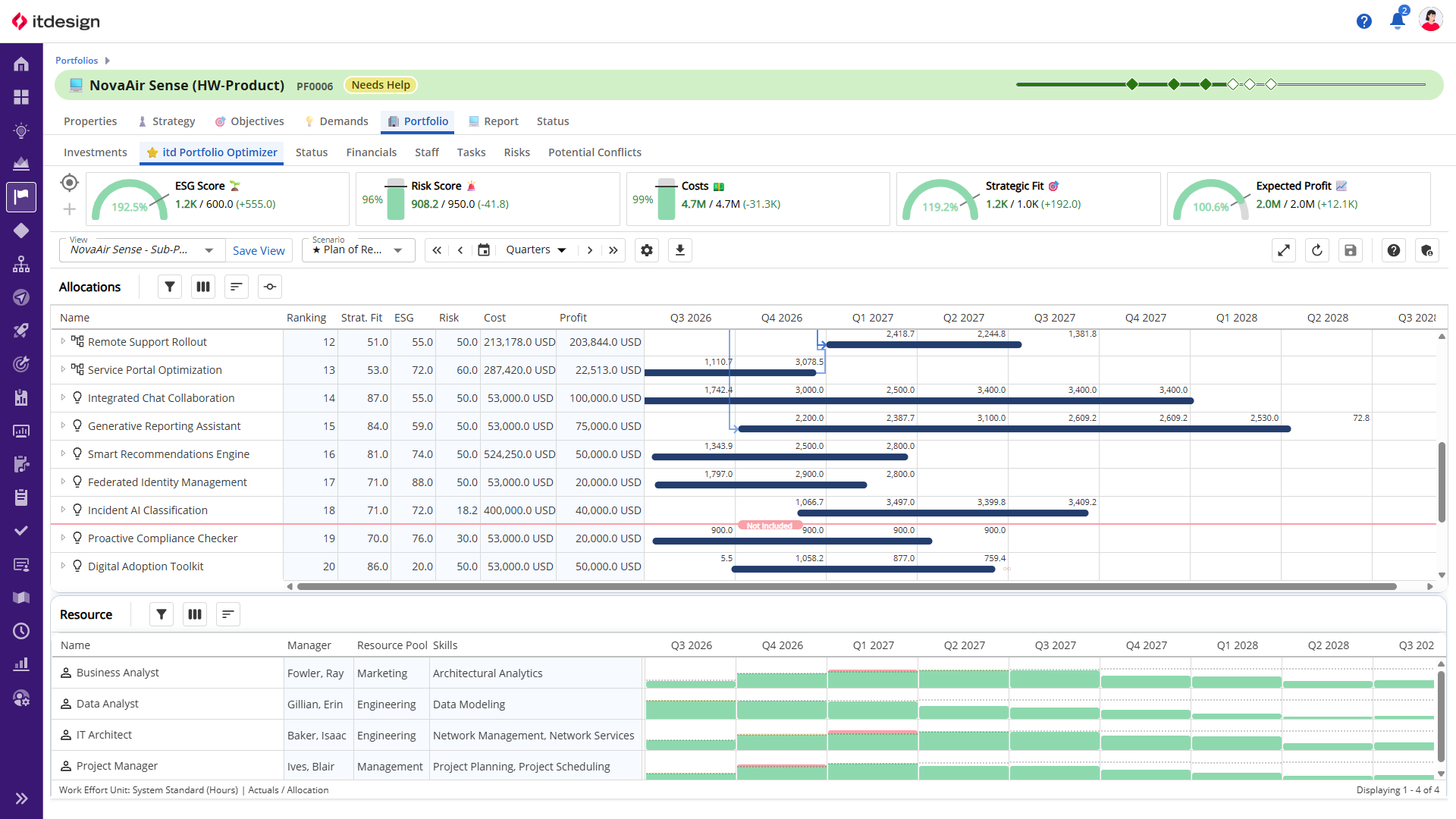
The best way to illustrate the theory is through practical examples. Let’s look at how Clarity connects strategy, initiatives, and resources within a centralized decision-making platform. Evaluations, prioritization, capacity planningCapacity PlanningCapacity planning describes the alignment between available resource capacity and the demand generated by projects., and scenario analysisScenario AnalysisSynonym for → ScenarioAnalysis of different planning scenarios. work together to provide the transparency needed for effective portfolio managementPortfolio ManagementPortfolio management is the strategic management of a set of projects, programs, or investments within a company..
Making Informed Decisions Through Data-Driven Evaluation
In strategic portfolio managementStrategic Portfolio ManagementStrategic portfolio management refers to the holistic management of all projects and investments within a company., initiatives are systematically assessed against an organization’s unique strategy. Typical criteria include:
- Strategic contribution to achieving business goals
- Business valueBusiness ValueBusiness Value measures the contribution an initiative makes to organizational goals and desired outcomes. and expected benefits
- Risks and regulatory requirements
- Sustainability and ESG considerations
- Effort, cost, and complexity
These criteria can be weighted flexibly. Individual assessments are consolidated into calculated metrics such as a Strategic FitStrategic FitStrategic Fit evaluates how closely an initiative supports an organization's strategic objectives. score or an ESG scoreESG ScoreAn ESG Score measures performance against environmental, social, and governance criteria.. This makes initiatives directly comparable. Discussions become more objective, and decisions become more transparent and defensible.
Consider project evaluationProject EvaluationSynonym for → Business Case AnalysisAnalysis of the economic value of a project. based on strategic contribution: initiatives with a strong Strategic Fit and clear business impact become immediately visible. Others intentionally remain in the pipeline as project candidates. A clearly defined cut-off or waterlineWaterlineA Waterline visualizes the portfolio boundary between feasible and currently infeasible initiatives. determines which initiatives are included in the portfolio and which are not – at least for the time being.
Realistically Account for Resources and Avoid Overload
Even the best prioritization falls short if execution is not realistic. That is why balancing demand and capacityCapacitySynonym for → AvailabilityGeneral term for available work capacity. is an essential component of portfolio decisions.
Strategic portfolio managementStrategic Portfolio ManagementStrategic portfolio management refers to the holistic management of all projects and investments within a company. evaluates resources at multiple levels – such as teams, roles, or specific skill sets. This assessment is based on net capacity, meaning the actual time available after accounting for vacations, meetings, and business-as-usual activities.
ProjectProjectA project is a temporary initiative with clearly defined objectives, resources, and a specific outcome. demand is then compared against available capacity. Bottlenecks become visible immediately. Overload can be avoided by rescheduling initiatives, reprioritizing work, or consciously postponing projects.
From One-Time Decisions to Continuous Portfolio Steering
Portfolios are not static. ProjectProjectA project is a temporary initiative with clearly defined objectives, resources, and a specific outcome. changes, new requirements, and shifting priorities have a direct impact on resources and strategic outcomes. Strategic portfolio managementStrategic Portfolio ManagementStrategic portfolio management refers to the holistic management of all projects and investments within a company. therefore enables continuous portfolio steering.
ScenarioScenarioA scenario is a simulated planning situation within a project portfolio. planning allows organizations to simulate different strategic directions – for example, placing greater emphasis on sustainability or budget efficiency – and transparently compare their consequences. Decisions are therefore not made just once but are continuously reviewed and refined.
Conclusion: Less Actionism, More Impact
Data-driven strategic portfolio managementStrategic Portfolio ManagementStrategic portfolio management refers to the holistic management of all projects and investments within a company. creates clarity, focus, and relief. Organizations make better decisions, allocate resources more effectively, and increase the impact of their initiatives. Clarity supports this as a central platform for projectProjectA project is a temporary initiative with clearly defined objectives, resources, and a specific outcome. and portfolio management.

The Five Most Important Takeaways
Good decisions require data – not gut feeling.
Only when initiatives are evaluated consistently and comparably can organizations make informed and transparent portfolio decisions.
Strategic contribution is the most important prioritization criterion.
Urgency and visibility should not drive decisions. What matters is the measurable contribution to corporate strategy.
Resource availability defines what is achievable.
Realistic planning is based on actual net capacity – not on the desire to accomplish everything at once.
Fewer projects mean greater impact.
A clear portfolio cut-off protects teams from overload and ensures focus on the initiatives that matter most.
Strategic portfolio management creates sustainable decision-making capability.
Through transparency, prioritization, and scenario planning, organizations remain agile and capable of action even in dynamic environments.
Ready for Better Decisions?
Talk to us about how you can use Clarity to sharpen priorities, reduce pressure on your resources, and achieve your strategic goals more effectively. Together, we can create the foundation for informed decisions and sustainable success.

Read Next